
7 Effective Channel Incentive Program Examples for Business Growth

Channel partners play a critical role in driving revenue, market expansion, and customer acquisition for manufacturers and enterprise businesses. However, simply onboarding distributors, dealers, resellers, or retailers is not enough. Keeping partners engaged and motivated to prioritize your products over competing brands requires a well-structured incentive strategy.

This is where channel incentive programs become essential. By offering performance-based rewards, rebates, loyalty points, and sales incentives, businesses can influence partner behavior, improve sales performance, and strengthen long-term channel relationships.

Modern channel incentive programs are increasingly powered by digital platforms that automate reward management, track partner performance, and provide real-time visibility into program effectiveness.

In this guide, we’ll explore seven proven types of channel incentive programs, their benefits, and how businesses can use them to increase partner engagement and maximize ROI.

Driving consistent revenue through channel partners isn’t just about onboarding more distributors or resellers—it’s about keeping them motivated to sell your products over competing brands.

In today’s competitive B2B landscape, channel partners have multiple options to choose from, and loyalty can shift quickly if there’s no clear incentive to stay engaged. This is why channel incentive programs have become a critical strategy for manufacturers and enterprises looking to increase partner performance, improve sales velocity, and maximize ROI.

From reseller incentive programs to channel rebate programs and performance-based rewards, businesses are now using a mix of structured incentive models to influence partner behavior and drive measurable results. If you’re exploring how to build a long-term partner engagement strategy, understanding the role of channel loyalty programs for B2B businesses can give you a strong foundation for aligning incentives with partner performance.

At the same time, many organizations are moving toward automation to manage complex partner networks more efficiently. Leveraging the right channel incentive management software helps streamline reward distribution, track performance, and ensure transparency across your channel ecosystem.

In this blog, we’ll walk you through seven effective types of channel incentive programs, along with their benefits and use cases, so you can choose the right approach to engage your partners and accelerate business growth.

1. Value-added reseller incentives

Value-added reseller incentives are the rewards channel partners receive when they add some additional value to enhance an existing product or service. The value addition can be in the form of an extra feature, integration, or product.

Benefits:

  • Handle complex IT projects
  • Increase market reach

A study by marketing insights firm Ariyh found that value-added reseller incentives can enhance a company’s overall sales by between six and nine%. The main advantages of value-added reseller incentives are they can enhance the value of an existing product as well as increase a brand’s market penetration. However, the biggest challenges of these types of incentives are they are extremely opaque.

Example

An electrical equipment distributor can qualify for value-added reseller incentives if they add some extra value (such as a special warranty) to an electrical product. Likewise, a paint dealer can get the incentive if they do the same with a paint product and sell it with additional offerings.

 2. Market development funds

These educational or monetary incentives are used to enhance local brand awareness and recognition. Manufacturers provide these incentives to their channel partners to generate brand awareness and sell certain products.

Benefits

  • Leverage partner market knowledge and power
  • Generate a measurable return

For instance, channel sales partners can use market development funds to organize a marketing seminar, conduct webinars, purchase radio advertisements, or exhibit space at trade shows. 

Example 

The biggest merits of market development funds are that by using them, B2B companies can leverage the influence and market knowledge of their channel partners as well as generate a quantifiable return on their investment. This channel incentive program faces some major challenges such as the offers lasting for only a few days or weeks and the terms and conditions being a bit too strict.

“As per one recent research, market development funds account for nearly half of channel marketing budgets, but just a quarter of B2B firms report that their incentives achieve the desired objectives.”

3. Sales performance incentive funds

These are performance-driven incentives that the sales team of a channel partner receives after meeting particular goals such as selling specific products. Sales performance incentive funds are extremely useful in increasing sales and driving short-term spurts during sales slowdowns or off-season.

Benefits

  • Increases sales momentum
  • Counter competitors
  • Helps target key individuals

The advantages of sales performance incentive funds are businesses can enhance their channel partners’ sales momentum, give strong competition to their competitors, and transfer the benefits to key members in their channel partner community. On the flip side, SPIFs are reactive and the incentives aren’t clear enough for channel partners’ sales teams.

Suggested Read: Why Channel Partner Loyalty Program Is Needed For Your Business

 4. Cooperative incentives

Also called CO-OP funding, cooperative incentives enable businesses to help channel partners achieve their marketing objectives. Previously, these incentives were distributed as account credits. But now they have become an integral part of channel loyalty programs. These incentives reward channel partners for their continued loyalty and sustained purchases.

Benefits

  • Opens doors to new ways of marketing
  • More money, more ads

 The most attractive benefits of CO-OP incentives are they enable B2B brands to have a local presence, which they won’t have otherwise, and they open new avenues for marketing. On the downside, however, cooperate incentives aren’t feasible for smaller B2B firms and they put an additional burden on a company’s marketing and sales team.

 5. Deal registration incentives

These incentives are run by vendors who provide channel sales partners with extra incentives if they manage to bring in new leads to the vendors. These are one of the most effective and useful incentive programs in channel partner marketing as they enable vendors to reward their channel partners who play a huge role in enhancing their market share.

Benefits

  • Enhanced efficiency
  • Increased partner satisfaction

Some of the advantages of the incentives are increased efficiency and enhanced channel partner satisfaction. One of the biggest challenges for this incentive is that the transaction complexity is huge and there are inconsistencies in complying with registration regulations.

6. Channel rebates incentives

These are volume-based incentives that are designed to motivate your channel partners to sell a specific volume of products that would enable them to earn their incentive and transfer the benefits to their customers. In channel rebate incentives, a channel sales partner must sell a specific volume of products to get the right incentives.

  • Retention rebate
  • Mix rebate
  • Volume rebate
  • Growth rebate

 The advantages of channel rebate incentives are they motivate channel sales partners to sell more of your products and build a strong customer base. The main challenges of channel rebate incentives are that they are a bit too complex and they require huge efforts and investment for proper implementation.

7. Channel referral incentives

Some channel partners have much stronger referral networks than their peers and this makes channel referral incentives one of the most preferable incentives for such channel partners. Some forms of referral incentives are debit cards, gift cards, incentive travel programs, and  points-based awards.

 Some merits of channel referral incentives are justifying the investment in rewarding channel partners is fairly simple and the results are visible. The challenges are the costs associated with these incentives are rather huge and the approach is quite new.

 Taking everything into consideration

Channel incentive programs are one of the most effective ways to improve partner engagement, drive sales performance, and strengthen long-term channel relationships. Whether businesses use rebates, performance rewards, loyalty points, or tier-based incentives, the key to success lies in aligning rewards with partner motivations and business objectives.

As channel ecosystems become more complex, businesses are increasingly adopting digital incentive management platforms to automate program administration, improve transparency, and maximize ROI. By selecting the right incentive strategy and supporting technology, organizations can create stronger partner relationships and sustainable channel growth. 

Looking to launch or optimize a channel incentive program for your dealers, distributors, or channel partners? Contact Us to discuss your requirements or Request a Demo to see how LoyaltyXpert helps businesses manage partner incentives and engagement at scale.
Everything about LoyaltyXpert’s all new Dual Wallet!

LoyaltyXpert’s dual wallet feature will enable brands to confer loyalty points in two categories to their channel sales partners. One is the primary wallet that will have the points that a specific channel partner can redeem for themselves. And the other one is the secondary wallet that will store a certain number of points and credit the suitable points to the subsequent channel partners under them.

A channel sales partner cannot redeem the points in the secondary wallet for themselves. Every time an invoice is approved by a channel partner, the system will check in the backend if the other customer/purchaser is eligible for points. If yes, that many points will be deducted from the approver’s secondary wallet.

The admin can also select if they can opt for the wallet functionality or the normal point system. To understand more about the dual wallet feature, let’s discuss how admins can assign approvers in the customer group, add primary and secondary points under different rules for various channel sales partners, and track the reports on their dual wallet transactions.

How admins can assign approvers in a customer group?

In the ‘Customer Group’ section, a new option called the ‘Approver Groups’ is included. In that, the admin can assign approver groups (the groups in the channel sales above the end-user) to maintain the hierarchy of the system.

If the new customer group is an end-user, then you can click on the box just below it, which says ‘Is this end user?’

When a customer group is marked as an end user then they won’t have access to the secondary wallet functionality and they won’t be allowed to be an approver.

There are also some opt-in boxes such as ‘Purchase Invoice’ and ‘Show This Customer Group In Mobile Registration Screen.’

After that, you can select KYC documents that you need to show for customers of this group in the mobile app. The KYC documents include:

  • Pancard
  • Aadhar Card
  • Driving License
  • Electricity Bill
  • Canceled Check

How to add the dual wallet to the Product rule?

If the client enables the dual wallet functionality, they can select the value they intend to give their channel sales partners in their secondary wallet.

The points in the secondary wallet are non-redeemable. They can only be transferred to the channel partners down the value chain when the invoice and purchase receipt is approved.

The channel partners can’t redeem the points in the secondary wallet for themselves and the points get credited to their channel partners down the value chain after the invoice and the purchase receipt are approved.

The product rule maintains the following parameters:

  • Rule name
  • Description
  • Based On
  • Customer Group Name
  • Product Name
  • Location
  • Action (Fixed/Percentage)
  • Value
  • Secondary Wallet Value

How to add the dual wallet to the Invoice Rule?

While creating an invoicing rule if the dual wallet functionality is enabled for the client, they can give extra points in their secondary wallets as well.

The invoice rule maintains the following parameters:

  • Rule name
  • Description
  • Start date
  • End date
  • Customer groups
  • Location
  • Action (Minimum Amount and Maximum Amount)
  • Action (Fixed/Percentage)
  • Value
  • Secondary Wallet Value

How to access dual wallet reports?

Under the transactional details section, two reports track the dual wallet transaction. The reports are:

  • Secondary wallet success reports
  • Secondary wallet failed transaction reports

In the secondary wallet success reports, the following details are maintained in this record:

  • Loyalty Transaction
  • Customer Membership ID
  • Loyalty Type
  • Transaction Type
  • Loyalty Points
  • Last Loyalty Points
  • Total Loyalty Points
  • Transaction Status
  • Transaction Details
  • Transaction At

In the secondary failed transaction report, the admin can view all the failed records along with the details of the loyalty transactions.

  • Loyalty transaction ID
  • Purchaser Name
  • Seller Name
  • Loyalty Type
  • Current secondary wallet points
  • Transaction Status
  • Transaction Detail
  • Transaction At

Special loyalty

Under the special loyalty section, the admin can now credit/ debit loyalty points in both the wallets—Primary wallet and Secondary wallet.

Admin can also bulk upload the point addition or deletion by selecting the following documents from the ACTION section.

  • Export Primary Wallet
  • Export Secondary Wallet

On the left, it has a ‘Wallet Type’ command that has two options—Primary Wallet and Secondary Wallet.

Special transactions in both Primary Wallet and Secondary Wallet have the following parameters:

  • Loyalty Transaction ID
  • Customer Membership ID
  • Transaction Type
  • Loyalty Points
  • Transaction Status
  • Transaction Detail
  • Transaction At

To know what we can do for your business, contact us today.

Know Every Relevant thing About your Electricians

If you are the owner or a marketer of an electrical equipment company, you should rope in the right electricians—the most important influencers in the industry—to take your brand to the next level. But before that, you must know some key things about them.

At LoyaltyXpert, we create a wide array of well-designed and effective brand loyalty programs, channel loyalty programs, and influencer loyalty programs for all sizes and types of electrical equipment makers. Providing our sophisticated loyalty solutions, we have forged robust relationships between some prestigious electrical brands and their partner electricians.

In this blog post, we discuss what relevant things electrical equipment manufacturers must know about their electricians so that they can design the most appropriate and effective electrician loyalty programs.

Understand your partner Electricians’ Psychology, Behaviors, and Mindset

Would you be surprised to know that a majority of electricians in your industry love attractive loyalty programs? Well, it shouldn’t but if you want some hard facts here you go. A renowned study found that eight out of every ten electricians said that they will stick with those electrical equipment manufacturers that have well-crafted influencer loyalty programs and two-thirds of them stated that their buying decisions are closely related to their ability to earn incentives.

  • This makes it obvious that electricians value good loyalty programs as much as any other influencers in various other industries. To design attractive loyalty programs, the very first thing you need to understand about your electricians is their psychology, behaviors, as well as their mindset. Decoding these three things can put you in an extremely advantageous position as well as help you collaborate with the most suitable influencers out there.
  • Electrical equipment manufacturers must understand that a majority of electricians are not conversant with technology. That’s the reason they should make the enrolment process extremely simple and also use offline methods to enroll electricians into their loyalty programs.

Apart from that, the manufacturers must bear in their mind that various electricians have their own motivations and values. Some of them are more likely to be driven by cash rewards, while some may value non-cash rewards. Knowing your electricians’ preferences and customizing loyalty programs accordingly will work like magic.
To create the right type of loyalty program, electric equipment manufacturers need to select reputable, trustworthy, and reliable loyalty software and platforms to create personalized loyalty rewards for various types of electricians.

Skills, Experience, and Expertise

  • The next important thing that you must know about your electrician is their skills, experience, and technical expertise. Different electricians in your loyalty programs will have different years of work experience and skills. Know the electricians who can provide your end customers with the best of their service and provide high-quality referrals to you.
  • To keep your electricians loyal, create suitable loyalty programs as per their skills and experience. Reward the more skillful and experienced professionals with higher tier-based and point-based loyalty programs, which will enhance their motivation and drive them to perform better.
  • When it comes to technical expertise, make sure that you provide easy access to product and technical information. Provide free online and offline training so that your influencer electricians can enhance their knowledge of your products. Also, provide them with proper tools and invite them to conferences, seminars, trade shows, and more such events.

Know their Customer Base and Popularity

  • When it comes to popularity and customer base, some trustworthy electricians fare better than others. Such electricians not only perform a wide range of electrical works but also provide product and brand recommendations to their customers. Apart from serving individual customers they also work with real estate builders as well as in various residential societies and commercial complexes, which enable them to influence the purchasing decisions of individual customers and organizational buyers.
  • When an electrician serves a large number of people and has a strong reputation among its clients, then your electrical brand can leverage that and gain high-quality referrals from them. For any electrical equipment manufacturer, such a partnership would be extremely advantageous and strategic.
  • That’s why while looking to partner with the right electricians, take a look at their existing customer base as well as their clout in the area they serve. After that, find out ways to forge strong bonds with those types of electricians and devise ways to retain their loyalty.

Taking everything into Account,

Electricians are the most important influencers in the electrical equipment industry. That’s why if you are planning to craft loyalty programs for electricians, you must know all relevant things about them and understand their mindset, psychology, and behaviors. At LoyaltyXpert, we can create the right electrician loyalty program for your brand that would help your electricians stay with you for a long time. If you want us to do just that, we are just a call away. To know what we can do for your business, contact us today.

What Is Channel Loyalty Program? How to Implement It Efficiently?

When a majority of businesses, particularly B2B companies and traditional manufacturers, take their products to the market, they need the help of several intermediaries such as distributors, dealers, wholesalers, resellers, stockists, and agents. As per Forrester’s research, channel sales partners account for three-fourths of global commerce. Most businesses, 63.5 percent of companies surveyed, said that they rely on their channel sales partners for a massive portion of revenue, found another research by CSO Insights.

This is where a well-designed channel loyalty program comes in. It focuses on enhancing the ties between a brand and its channel sales partners from a transactional relationship to an emotional and longstanding one.

At LoyaltyXpert, we have crafted channel loyalty programs as well as brand loyalty and influencer loyalty for all sizes and types of businesses across industries. In this blog post, we discuss the steps to implement channel loyalty programs effectively.

1. Determine what you want from the partnership and set SMART goals

First thing first, decide what you want from the channel partnership and set SMART (specific, measurable, attainable, realistic, and time-bound) goals. This will help you get a clearer picture of why you want to get started with a channel sales program in the first place.

While setting the goals take all the necessary steps to identify the key performance indicators (KPIs) and clearly define the expectations and responsibilities for your channel sales partners. Chalk out the things your channel sales partners need to do and define a clear channel partnership structure.

2. Handpick the right channel sales partners

After deciding the things you want from the partnership and setting the SMART goals, it’s time to handpick a select number of channel sales partners according to the types of partners you want. This is where you need to spend quality time researching the background and experience of the prospects.

While making any decision, make sure that you test their product and industry knowledge as well as understand their motivational drivers. Find out if they are already dealing with any of your competitors and how much volume they are selling. Also, try to get the right mix of channel partners for better speed to market.

3. Provide adequate training to your channel partners

After choosing the right channel sales partners, you need to focus on the training needs of your channel partners. Make sure that you have the bandwidth to create useful and valuable and relevant content for your channel partners so that they can know everything about your products before dealing with them. Training manuals, modules, videos, and forums are great support platforms for channel sales partners.

Even though training channel sales partners will cost some time and money, the results will be worth a lot more than the investment. It will motivate them to give their best efforts and walk the extra mile with you. Apart from increasing the average partner satisfaction score, effective training will also enhance the average sales cycle length.

4. Choose a sophisticated loyalty platform

To create a successful channel partner program, make sure that you choose a highly sophisticated loyalty platform that can help you craft tailored and well-design channel loyalty programs. But the challenge is the market is flooded with a plethora of loyalty platforms and it’s extremely crucial to find the right one for your business.

To be able to do that, take a look at some of the most reputable loyalty solution providers out there and compare their features, specifications, and price. Find out if the platform can help you scale up your brand loyalty and channel loyalty programs as you grow in size. Apart from helping you design customized channel loyalty programs, the right loyalty platform can do a lot of things such as calculate the revenue generated by your channel sales partners and streamline all relevant channel data.

5. Monitor the results and analyze the outcomes

After setting the goals and running the loyalty programs, the final step is to monitor the results and check the gaps between them and the expected outcomes. Make sure that you define the key performance indicators to efficiently measure the success of your loyalty programs. A sophisticated loyalty platform will help you in tracking all necessary channel data and access the performance of each channel sales partner.

After measuring the outcomes match them with the expected or desired objectives of the channel loyalty program. If the obtained results are on par or better than the set goals, then the loyalty program is on the right course. However, if the actual results fall short then you need to find out the problem areas and take corrective actions to bring the program on the right track.

Taking everything into account,

Every business that relies on sales channels must implement a channel loyalty program to motivate their channel sales partners and keep them loyal for a long time. At LoyaltyXpert, we create channel loyalty programs for all types of businesses, especially traditional manufacturers and B2B companies, and help them forge strong bonds with their channel sales partners. If you are considering creating a channel loyalty program for your business, then contact us today to know how we can help.

Ways to optimize your channel loyalty program in 2022

Manufacturing businesses and B2B marketers have always been devising ways to motivate their channel sales partners and build long standing relationships with them. Before the rapid technological changes, B2B brands used several conventional strategies to engage various channel sales partners and keep them loyal.

But the times have changed. With the latest digital breakthroughs, B2B brands need innovative and out-of-the-box strategies to optimize their existing loyalty programs. Are you considering optimizing your existing channel loyalty program?

At LoyaltyXpert, we have helped many types of manufacturers and B2B companies across industries optimize their channel loyalty, Influencer loyalty and brand loyalty programs. In this blog we discuss the current trends in channel loyalty marketing and how B2B businesses leverage those to optimize their channel loyalty programs.

Key trends in channel loyalty marketing for 2022

When it comes to optimizing channel loyalty programs, it is crucial to know the key trends that are shaping the channel loyalty landscape in 2022. Here are five key trends in present-day channel loyalty marketing.

1. Data-driven decisions

Data is extremely valuable to manufacturers and B2B marketers. It can help in understanding channel sales partners and other buyers in the value chain. Many leading B2B businesses are collecting, analyzing, and segregating relevant data on different channel partners to make informed decisions. By leveraging data and insights, B2B businesses can get positive results and monitor their key performance indicators as well as return on investments.

2. AI-powered platforms

Many successful manufacturing and B2B companies are leveraging artificial intelligence. By using sophisticated loyalty platforms, they are automating their channel loyalty programs. It is enhancing their efficiency and efficacy. By using AI, manufacturers and marketers can craft highly personalized and targeted rewards and marketing strategies for their channel sales partners.

3. Digital transformation

Digital transformation is a critical success factor for every business, especially for traditional manufacturers and B2B companies. Many astute entrepreneurs and marketers are transforming their loyalty marketing strategies to keep pace with the changing times. The best-performing businesses have started adopting innovative digital technologies to enhance the efficiency and value of their channel loyalty programs.

4. Mobile-specific strategies

Smartphones and tablets have taken a huge prominence in nearly everyone’s lives. So, how can loyalty programs remain excluded from that? With the majority of channel sales partners using smartphones and tablets to run their operations, it’s prudent for traditional manufacturers to make their channel loyalty programs mobile-friendly. Many successful and reputable manufacturers are making their channel loyalty programs mobile-friendly. Some of them are gamifying their channel loyalty programs and making them compatible with smartphones and tablets.

5. Multi-channel programs

In addition to focusing on mobile devices, many manufacturers and B2B marketers are using more than one channel to reach their channel sales partners. By leveraging multiple xpert channels such as email, SMS, social media, and other communication tools, B2B companies are enabling their channel sales partners to avail attractive rewards and loyalty benefits from their most preferred options. Providing multi-channel experiences is proving to be crucial for the success of many channel loyalty programs.

Ways to optimize channel loyalty programs

At present, optimizing channel loyalty programs is extremely necessary for traditional manufacturers and almost all types of B2B companies who aim to succeed amid the rising competition. Here are five ways a business can optimize its channel loyalty programs.

1. Use a high-quality loyalty platform

Select a reputable and trustworthy loyalty service provider and get an advanced and high-quality loyalty platform from it. Make sure that the platform has sophisticated features that will enable you to run your channel loyalty program smoothly. Some of the best-in-class platforms are powered by AI. Check the analytics and reporting feature to measure and track the performance of your channel partners. Ensure that the platform can enable you to configure loyalty rewards, design tailored channel partner incentive programs, and help you to remain flexible and responsive in the fast-changing times.

2. Personalize and customize rewards for various channel partners

After partnering with the right service provider and getting the most suitable loyalty platform for your business, create targeted and personalized partner programs for your different channel partners. Use a mix of cash and non-cash rewards and provide attractive rewards and incentives that will inspire your channel partners to enhance their performance. Provide incentives and rewards to channel sales partners for referrals. Also, make use of points-based rewards and membership programs to inspire your sales partners to raise the bar for themselves and others.

Also Read: How to Personalize Channel Loyalty Programs for Distributors, Dealers & Retailers

3. Leverage data and analytics to track performance and make informed decisions

Data is like gold dust for B2B manufacturers. It can help in finding out if the rewards and incentives are working or not. It will also provide key insights into the behavior and performance of individual channel sales partners and will help businesses take corrective actions. Use the analytics and reports to find all crucial key performance indicators associated with your channel loyalty programs.

4. Make your channel loyalty programs mobile-friendly

One research jointly conducted by Salesforce Marketing Cloud and LinkedIn revealed that 86 percent of B2B marketers using mobile-focused channel loyalty strategies found them to be extremely effective. Make your channel loyalty programs mobile-friendly as well as optimize them to be compatible with multiple channels.

5. Collaborate with the right channel sales partners and make your brand resonate with them

Apart from crafting and curating the most suitable rewards and incentives for channel partners, it is extremely important to choose the right distributors, stockists, and other resellers who can work closely with your brand. Also, make your brand’s value resonate with your channel sales partners so that you can keep them invested in your business for a long time.

On the whole,

Contemporary businesses should be ready to embrace changes and tweak operations. Optimizing channel loyalty programs can help manufacturers to stay relevant in the current time. If you are looking to optimize your channel loyalty programs, contact the team of LoyaltyXpert today.

Influence Purchase Decisions with B2B Influencer Loyalty Program

B2B influencers play a huge role in influencing B2B buying decisions. As per a report published in Forbes, about two-thirds of B2B marketers opine that B2B influencer marketing enhances brand exposure and tilts the buying process in their favor.

However, just 19 percent of them implement the marketing tactic in their organizations. Like brand loyalty and channel loyalty programs, B2B influencer loyalty programs can generate a lot of revenue and bring a lot of positive results.

At LoyaltyXpert, we craft high-quality and personalized B2B influencer loyalty programs for a wide array of B2B companies. We have experienced the power of B2B influencer marketing, up close.

In this blog post, we discuss the benefits of B2B influencer loyalty programs, how to find and select the right B2B influencers, and the most effective ways to implement B2B loyalty programs. Read on to know more.

Why B2B influencer marketing is effective for B2B companies?

B2B influencer marketing is emerging as one of the most effective marketing tactics for B2B businesses. It has the potential to generate millions of dollars in revenue every year. Here are four reasons why B2B influencer marketing works like magic in the B2B space.

1) B2B influencers have a select group of audience

Unlike celebrities and popular public figures, B2B influencers have an extremely specific and select group of audiences, who are interested in their niche content. They are followed by just one industry audience and their recommendations can influence the opinions, thoughts, and purchasing decisions of their followers.

To give an example, a celebrity who is a brand ambassador of an IT company can also endorse an automotive brand. But that’s not the case with influencers. A B2B tech influencer creates content that’s only related to technology, software, hardware, computer accessories, electronics, and more.

If you’re a software solutions provider, you can find B2B tech influencers who specialize in the domain. They demonstrate a wide range of software and IT services and share their experiences, suggestions, and reviews. If you create the right influencer loyalty programs for them, you can forge a strong synergy and reach out to thousands of their followers.

2) Close and personal connection with their audience

Influencers, both B2B and B2C, have an exceptionally close and personal connection with their audience. They connect with their followers regularly. Apart from giving tips, showcasing various products, and sharing their experiences, they also show their lifestyle and some aspects of their personal life, which builds a kinship with their audience.

Apart from that, they regularly conduct livestream, answer the questions of their followers, and also reply to their comments and direct messages. By doing so, they win the trust of their followers and subscribers. They also upload content and social media posts consistently, which earns them more followers.

3) B2B influencers are the experts in their industry

B2B influencers have made a name for themselves due to their expertise and knowledge of a specific niche or industry. More often than not, they are noted and well-respected thought leaders, industry analysts, and industry body experts. They are regarded as the experts in their industry. That builds trust and makes their followers think that they are right.

Six in every ten marketers believe that influencer-generated posts get more views and engagement compared to branded content. Nearly the same number of customers tried a brand’s product or service as it was recommended by an influencer they follow.

4) Higher ROI and revenues

As per some studies, influencer marketing gives eleven times more return on investment than any other form of digital marketing. Apart from enhancing the return on investment, B2B influencer marketing also increases revenue.

One research conducted by influencer marketing platform SocialPubli.com found that four out of every ten marketers said that their influencer marketing campaigns generate the highest revenue out of all marketing techniques.

How to find and pick the right B2B influencers in your industry?

Finding the right B2B influencers in your industry can be challenging without a well-designed strategy. But with the right plan and tools, you can find and partner with the ones that can take your business to new heights. Here are five effective ways.

1) Use the internet

While finding out the right B2B influencers for your business, use search engines such as Google and Bing as well as social media platforms such as LinkedIn, Twitter, Facebook, Instagram, and more. Even though it’s natural for top influencers to have considerable followers, don’t focus solely on their social strength. Look at their content, expertise, and how well they can work with your brand.

2) Monitor your industry and competitors

To select the right B2B influencers for your brand, keep a close watch on your industry as well as the best-performing competitors. Find out the influencers they are partnering with and the types of content they are creating. Look for some best content in your industry and niche. Also, look at the trends and projections. All these will help you partner with the right kinds of influencers in your niche.

3) Attract influencers to your brand

In addition to looking for the right influencers for your brand, you can try the other way round. Creating a community of B2B influencers is one of the best ways to attract the right ones to your brand. Build an excellent website and create awesome content to catch the attention of some acclaimed opinion leaders and experts in your industry.

4) Create a B2B influencer dossier

After selecting the right B2B influencers, create a dossier to list their talents, strengths, weaknesses, and interests. It will also help you to list their social channels, media coverage, history of work, and more.

5) Invest time in product education and co-creation of content

To be effective, the B2B influencers partnering with your brand must have detailed knowledge of the products they will be promoting. You need to explain to them how each of your products works and what features they need to highlight. After educating them about the products, focus on content co-creation. Invite ideas from them and encourage them to use their creativity, expertise, and storytelling skills to create engaging and informative content.

Tried and tested ways to implement B2B influencer loyalty programs

If you are planning to implement influencer loyalty programs then these five tips can be extremely beneficial for you.

1) Have an effective influencer referral program in place

If you’ve subscribed to some influencers on YouTube you might have seen them discussing or reviewing a product and then providing an exclusive coupon code, which has their initials. That’s nothing but an influencer referral program. In that, companies provide influencers with exclusive coupon codes, using which their followers can avail of attractive discounts. By creating an influencer referral program, you can create personalized coupon codes for certain influencers in your industry and connect with their followers at once.

2) Turn your audience into B2B influencers

Can your channel partners and target audience be B2B influencers? Some of them may not have the professional title of ‘B2B influencers’ but they know how to leverage the power of social media to share their experiences and opinions with their friends and followers. The best part is, that some of them have the following and clout that can make them micro-influencers. All you need to do is identify and encourage them to create testimonials, write reviews, give ratings, and help in creating user-generated content. 

3) Create a community for B2B influencers and micro-influencers

Building a community of B2B influencers is one of the most effective ways to partner with the right B2B influencers. Rewarding the members with personalized experiences, extra benefits, and perks will also attract more B2B influencers and micro-influencers to be a part of your online community.

4) Craft a tiered membership program

A tiered membership program can be extremely effective in influencer marketing. It usually has tiers such as ‘Diamond,’ ‘Platinum,’ ‘Gold,’ and ‘Silver,’ which rank the influencers as per their performance. It felicitates the best-performing B2B influencers and enhances the competitive spirit.

Customize rewards and compensation

Instead of having identical rewards and incentives for all B2B influencers, focus on customizing and personalizing the compensation to motivate and retain them in the long run. Use a mix of cash and non-cash rewards as well as provide exclusive access to, and experiences of, upcoming products and services.

All in all,

Even though B2B influencer programs can enhance brand value and generate a lot of revenue, a lot of B2B companies are yet to leverage the marketing tactic to their benefit. This is where a reputable and trustworthy loyalty service provider such as LoyaltyXpert can help. We can craft a wide range of personalized and high-quality B2B influencer loyalty programs. Call us today to know how we can help you with it.

6 Reasons to Implement Channel Loyalty in Paint Industry

Manufacturing high-quality paints and coatings is half the battle. The other half is choosing the right distributors and resellers to get the products to market. For that, you need to run an effective channel loyalty program for your channel partners—your distributors and all types of resellers.

By leveraging a well-designed channel partner loyalty program, you can provide a value-added experience to your channel partners and motivate them to promote your brand more.

At LoyaltyXpert, we have implemented several tailored, effective, and successful painter loyalty programs for many reputed paint brands and helped them achieve greater profitability and superior results.
In this blog post, we list six reasons to implement channel partner loyalty programs for paint brands. Read on to know more.

1. Gain a competitive edge in a highly competitive and consolidated market

The Indian paint market is an extremely competitive and highly consolidated sector. There are many paint manufacturers in the country and the number is rising with each passing year. However, just five paint brands account for nearly 70 percent of the total market share. Rest others contend for the remaining 30 percent.

It’s a known fact that the top brands invest heavily in all marketing strategies at their disposal, which also includes channel loyalty programs and influencer loyalty programs. When a new, or established, paint brand runs a well-designed and customized channel loyalty campaign, it gets a massive competitive advantage over its competitors who don’t leverage the loyalty program.

2. Massive scope in a rapidly-growing sector

The paint industry provides huge growth potential and the market for industrial and decorative paints is rapidly growing. As per Fortune Business Insights, the global market size of paints and coatings is projected to reach US$235.06 billion by 2029 from US$167.04 billion in 2022 at a compounded annual growth rate (CAGR) of five percent in the period.

As per Statista, the Indian paint industry is worth more than Rs. 62,000 crores (US$8 billion), and the trade value stood at Rs. 57,000 crores (USD 7.13 billion). As per another study by Mordor Intelligence, the paints and coatings market is estimated to grow at an eight percent CAGR between 2020 and 2025.
A well-designed channel loyalty program offers immense scope for profitability in the rapidly-growing sector. By leveraging an effective channel loyalty program, a paint brand gets immense opportunities to tap into a rapidly growing market.

3. Access to a wide range of expertise and resources

We all know what the right channel partners can bring to the table—their expertise, resources (both financial and non-financial), influence, and more. By running well-designed channel loyalty programs, paint brands can access a wide range of experienced and skillful human resources as well as various other resources such as finance and customer support.

A group of efficient and competent channel sales partners act as an external sales team. But the only difference is instead of a fixed salary, the rewards are linked to their performance. If the incentives and rewards are worth their time and efforts, they will do whatever it takes to deliver their best performance and results.

Reputed distributors and resellers also enjoy a decent following and clout in their respective areas, which enable them to influence the purchasing decisions of their buyers. This can give sufficient leverage to paint brands to sell more of their paint products and tools.

4. Opportunity to build trust and establish credibility

Did you know that a strong and high-quality channel partner loyalty program can enhance a paint brand’s market credibility by leaps and bounds? When a new or upcoming brand runs a channel loyalty program that’s as effective as the programs of some most successful brands, then the former gets an opportunity to be trusted and respected as the latter.

At present, all leading paint brands invest heavily in channel partner loyalty programs, which work like magic for them. A new, or established, paint brand can gain credibility by implementing an efficient channel partner loyalty program.

Investing in channel partner loyalty programs also incentivizes and motivates channel sales partners to promote a paint brand more.

5.Cost-effective and excellent return on investment

As we are already aware, the cost of acquiring a new distributor or reseller is much higher than retaining an experienced and loyal channel partner. So, it’s not surprising to know that channel partner loyalty programs considerably reduce channel partner acquisition costs. But effective channel loyalty programs can substantially reduce operational costs such as support costs and

Being highly targeted, channel partner loyalty programs save brands a lot of money and give a high return on investment. When done right, an effective and efficient channel partner loyalty program can be extremely cost-effective compared to many other advertising and marketing campaigns and can provide excellent return on investment.

Also Read: How to Make Painters Your Brand Ambassadors and Drive More Sales?

6.Robust relationships with partners

Well, this one is a no-brainer. The very purpose of a channel loyalty program is to make channel sales partners fall in love with a brand and keep them loyal for a long time.

Well-designed and tailored loyalty programs not only retain highly efficient and productive channel sales partners and motivate them to generate more business, but also build enduring relationships that last for several years and decades.

Well-established channel loyalty programs enhance the communication between brands and channel sales partners and also keep the feedback loop open.

Everything considered,

The journey of your brand’s paints from your factory to the market can be indeed long without a well-designed channel loyalty program. At LoyaltyXpert, we have crafted high-quality and tailored channel loyalty programs for many reputable paint brands and helped them achieve desired results. If you are looking to run effective channel loyalty programs for your paint business, then contact us to know how we can help you achieve your objectives.

8 Most Common Reasons for Failure of Channel Loyalty Programs

Winning your channel sales partners’ loyalty can be the key to your B2B business’s success. For that, you will have to invest in a sophisticated loyalty program software as well as introduce attractive and engaging B2B loyalty programs.

But will that guarantee the success of your channel partner loyalty programs? Unfortunately, the answer is no. Even after launching a strong and fool-proof loyalty program, there is a chance, no matter how small, that it won’t work.

Some factors can work against the success of your channel loyalty program and let it down. This blog post discusses the seven most common factors that cause loyalty programs to fail. Read on to know what those are.

Not understanding channel partners and not taking their perspectives into account

The most dangerous mistake that a B2B company can make is to take their channel partners for granted, not understand them, and ignore their perspective. Not every channel partner is equal. That’s why it’s crucial to know all the key things about all your channel partners.

Understand what your channel partners value in a partnership. How do they perceive your brand and how important it is to them? How many brands do they deal with and are they dealing with any of your competitors? Would they prefer to promote your brand before others?

When it comes to forging a strong relationship, transactional and cash rewards aren’t just sufficient. A study found that 77 percent of channel loyalty programs, which only use transactional rewards, fail within the first two years of launch.

Lack of clear and measurable goals

After taking care of the qualitative aspect, it’s time to pay attention to the quantitative aspects of the channel loyalty program. Make sure that the goals are extremely clear and measured. Determine the growth in market share, sales, and revenue you want to see after launching the program.

Also, find out if your focus is more on the acquisition or retention of channel partners? At present, retaining the existing partners is much more feasible than acquiring new ones. But a recent survey revealed that 82 percent of B2B marketers focus on acquisitions compared to just 48 percent who focus on retention. Make sure you have the answer to the question before starting with the program.

Apart from setting your own goals, ascertain and understand your channel partners’ goals. This will ensure that both your and your channel partners’ goals are aligned. Communicate the goals to your sales and marketing team. After setting the objectives, select the best way to achieve them.

Lack of commitment

A channel loyalty program is a long-haul game. The results will take time, effort, resources, and dedication. But it will be completely worth the wait, patience, and investment. Make sure you have the patience and perseverance to remain committed to it for as long as it may take. An unwavering commitment is a must for a channel loyalty program.

At a time when 40 percent to 50 percent of B2B brands have the same vendors for at least five years, reveals a B2B International survey, be prepared for a long-term commitment and refrain from immediate gratification.

Make sure you have an absolute buy-in from key stakeholders as well as assign a dedicated program manager to supervise the loyalty program’s momentum and report the progress and developments to the senior management.

No personalization

When a B2B company deals with a wide range of channel sales partners such as dealers, sub-dealers, distributors, wholesalers, stockists, etc, it’s crucial to personalize the incentives and rewards for each segment.

But as per a recent study, only 29% of B2B clients consider themselves fully engaged with their vendors. It takes away the opportunity from them to understand what kinds of rewards their channel partners would appreciate and customize accordingly.

Make sure that you understand your trade associates and be clear about what behaviors you intend to encourage and reward accordingly. Don’t solely rely on transactional and monetary rewards. A study revealed that businesses that use non-transactional and recognition rewards for their channel loyalty programs register an average revenue growth of 10 percent per year in contrast with 3 percent for the organizations that use transactional and cash rewards. Apart from that, consider the language barrier and other geo-cultural aspects while communicating with them.

Inadequate or improper resources

If the resources fall short or are not up to the mark, then it will cause the loyalty program to fail miserably. Resources can range from anything and everything from reliable and sophisticated channel loyalty program software to actual rewards and incentives.

The first step to making sure that the resources are adequate and suitable is to set a reasonable budget for the program. After that invest in a high-quality loyalty program software. Make sure the incentives and rewards are attractive, relevant, and riveting.

Over-complicated program structure

Another major reason for the failure of a loyalty program is its over-complicated program structure. Complex structures disengage partners and prevent them from being a part of the journey.

To make the program structure simple, make sure the terms and conditions are easy to understand. Make the sign-up simple and hassle-free. Ensure the incentives and rewards are achievable after putting in a reasonable amount of effort. Avoid making any big changes if not necessary and make sure the changes are well-thought-out and well-communicated to the partners.

Inability to leverage key data

Data are extremely important for loyalty programs but some B2B companies make the mistake of not leveraging enough data. For instance, a well-known study found that only a handful of B2B companies use the right metrics to track their loyalty programs and omnichannel experiences.

If you want your channel loyalty program to succeed, then track all key data and leverage them to enhance engagement and results. Keep sophisticated analytical tools in place to monitor the overall progress of loyalty programs. Check redemption rates and review channel loyalty metrics and other parameters to make sure that the program is well-oiled.

Putting the programs on autopilot mode

Some B2B businesses tend to put their channel loyalty programs on autopilot mode after launching them. They treat it as something as if it can run on its own without the intervention of anyone. This brings the programs down.

To make your program work, promote it throughout the year and not just during and some days after the launch. The key is to assign responsibility to some key team members to track and promote the program.

Summing up,

For a B2B business, a strong and successful loyalty program is extremely crucial for engaged and motivated channel sales partners. But even after creating a well-planned loyalty program and investing heavily in it, some programs are destined to fail. Are you worried that your channel partner loyalty program won’t work? Don’t worry. At LoyaltyXpert, we designed customized and successful channel partner loyalty programs for all types of B2B businesses by leveraging our advanced loyalty program software. Contact us today to know how we can help.

7 Steps to Build an Efficient and Effective Channel Loyalty Program

Just imagine how awesome it would be if your channel sales partners exclusively sell your products or solutions. But sadly that isn’t the case. Apart from selling your offerings, they also deal with your competitors.

So, how do you ensure that they remain loyal to you? By creating effective and excellent channel loyalty programs for them. Your competitors are investing, or going to invest more, in channel loyalty programs. As per one recent data from SmallBiz Genius, nearly 65 percent of B2B companies plan to apply for a new loyalty program or upgrade their existing programs over the next 12 months.

At LoyaltyXpert, we have enabled many businesses to create effective channel partner loyalty programs and B2B Loyalty programs by using our sophisticated loyalty program software. If you’re looking to create an effective channel loyalty program, then these seven strategies will help you to create an effective and excellent channel loyalty program.

1. Set goals and define responsibilities

The very first step of building a successful channel loyalty program is to set goals that are SMART—specific, measurable, attainable, realistic, and time-bound. First of all, determine what you want from the channel partner program. Do you want to increase the sales of your entire product range and enhance your market share? Do you intend to add more channel partners and expand your existing channel? Some other goals can be to enhance partner registration rate, partner lifetime value, channel retention rate, partner redemption rate, repeat purchase rate, referral rate, SMS subscriber count, and more.

When setting goals, make sure to identify the key performance indicators (KPIs) and define responsibilities for your partners. Build a feasible and detailed timeline as well as select a launch date, and fix the completion date.

2. Select qualified channel partners

In an open and free market, there will be a huge number of sales intermediaries. But among them, you need to choose the most suitable ones to be your qualified channel partners. Choosing the right ones will help you achieve your objectives quickly and effectively.

During the selection process, determine how well they know your products and offerings. Find out who can enable you to expand your products and solutions swiftly and steadfastly. Understand their commitment to your products or solutions. Find out the average volume they sell on an annual basis. Also, know about their engagement with your competitors.

If you’re a manufacturing company, then dealers, distributors, retailers, and sales representatives are suitable qualified channel partners. If you’re a vendor, then agents and retail partners are the right qualified channel partners.

3. Determine the training needs of the potential channel partners

After handpicking the right qualified channel partners, determine their training needs and what they need to be trained on. Do they need to be trained on products and solutions? Or communication and marketing strategies? Do they know how to cross-sell and upsell products and solutions?

After finding out answers to the relevant questions, create training modules for each of them. While distributors and sales representatives will require more product training, some channel partners will need to be trained on how to handle the products and give demos.

While imparting the training, make sure to make the modules as engaging, comprehensive, and informative as possible so that your channel partners won’t forget the crucial details and spend time re-learning those.

4. Select a suitable channel loyalty program and define rewards for each channel

After knowing more about your channel sales partners and determining their training needs, select the type of channel partner loyalty program that’ll be suitable for your business and work best for you. After that, define the most suitable rewards for each channel to enhance your channel partners’ value in the ecosystem.

This will enable the channel partners to get rewards as per their performance and outcomes. Also, it will allow them to receive their preferred rewards. A wholesaler is more likely to value special discounts for bulk orders or flat tariff schemes, while a retailer will be more excited about branding and targeted promotion for different customer groups.

5. Select the right channel loyalty platform

Selecting the most suitable loyalty platform is the key to tailoring the most efficient and effective loyalty programs for your channel partners. So, among a large number of loyalty solutions providers, how do you know which is the right one for you? There are many ways to do that.
Search for some of the most reputable and trustworthy channel loyalty platform providers. Find out if they can customize tailored channel loyalty programs. Also, contact them and ask for a demo to know more about their channel loyalty solution.

One such platform is LoyaltyXpert, which offers a wide range of features and customized channel loyalty solutions to help businesses reward and motivate their trade associates. By using our advanced and sophisticated loyalty program software many businesses have achieved desired results from their loyalty campaigns.

6. Keep the communication channels open for channel partners

After selecting the right channel loyalty platform, make sure that you have a proactive and responsive communication strategy to communicate with channel partners effectively. Leverage suitable communication tools to communicate with channel sales partners.

Send SMS and emails regularly to keep in touch with them and communicate important messages. Segment your channel partners to make the communication and message more relevant. Have direct communication to develop a robust relationship.

7. Track results and modify the approach to meet expectations

This is the last but extremely important step in creating a channel loyalty program. The first step starts with setting goals and the final step is to ensure that you achieve the desired results. Look at the KPIs as well as the other objectives and find out how many of them have been achieved.
If you’ve ticked a majority, or all, of the boxes then all kudos to you. You’ve done a great job! But if you’ve been unable to achieve some key goals, then it’s time to go back to the drawing board and modify your approach to meet expectations.

Overall, it may be said,

In a time of rising competition, creating an effective channel loyalty program is extremely crucial for B2B businesses. It will help them to keep their channel sales partners engaged and committed to their business as well as result in more sales, revenues, and profits. If you’re looking to create engaging and effective channel loyalty programs, then consider the solutions of LoyaltyXpert.

How QR Codes Are Shaping the Future of Loyalty Programs?

A customer walks into your store, makes a purchase, and leaves without signing up for your loyalty program. Weeks later, they buy from a competitor because your offers didn’t reach them on time. 

For businesses today, this is a common pain point. Retaining customers and engaging them effectively is more challenging than ever in a mobile-first world.

This is where a QR code in a loyalty program comes in. By integrating QR codes into loyalty systems, businesses can engage customers instantly, collect critical data, and deliver personalized experiences without friction. With smartphones in nearly every pocket, consumers now expect digital loyalty programs that are simple, fast, and rewarding.

Modern app-based loyalty programs like LoyaltyXpert leverage QR codes not just for point collection or coupon redemption, but also for tracking behavior, gathering insights, and personalizing offers. Whether it’s a first-time shopper or a long-term customer, QR-enabled loyalty solutions make it easy for businesses to connect, reward, and retain their audience efficiently. 

The Rise of QR Codes in Loyalty

Over the past few years, QR codes have moved from novelty to necessity in customer  engagement. Globally, studies show that over 80% of smartphone users have scanned a QR code at least once, and regular usage is increasing steadily. In India, QR code adoption is booming, driven by mobile payments, digital wallets, and the growth of loyalty program companies in India offering seamless digital experiences.

Businesses are increasingly using QR codes in loyalty programs to reduce friction, enhance convenience, and drive engagement. Contactless, mobile-friendly solutions are no longer just an option—they are expected by consumers who want fast, reliable, and personalized interactions.

The future of loyalty programs is digital-first, with QR codes at the center. From dynamic QR codes loyalty campaigns to integrating with loyalty software for business and app-based loyalty programs, companies are now able to track engagement, measure ROI, and deliver timely rewards. This evolution is redefining loyalty, making it more accessible, scalable, and measurable than ever before.

Core Use Cases of QR Codes in Loyalty Programs

When QR codes first appeared in 1994, no one imagined they would become the backbone of modern loyalty programs. Today, almost every QR code loyalty program uses them to simplify customer journeys, personalize experiences, and capture real-time data. Here’s how businesses are leveraging QR codes in loyalty programs across different touchpoints.

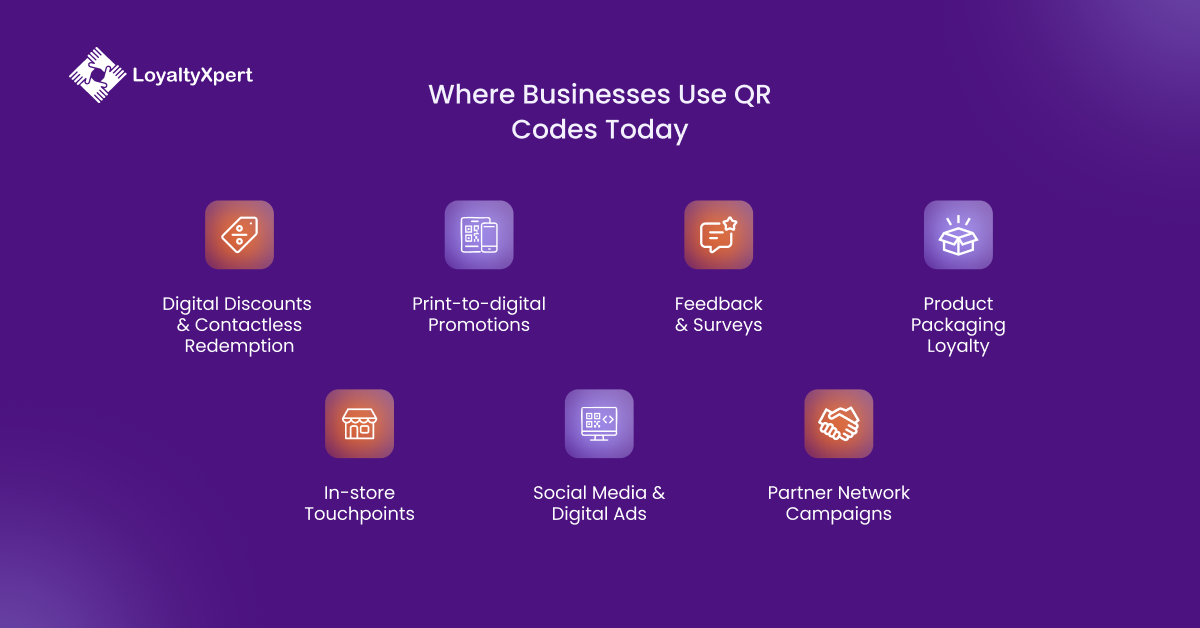
Where Businesses Use QR Codes Today

1. Digital Discounts and Contactless Coupon Redemption

QR codes make coupon distribution effortless. Instead of printing physical vouchers, businesses now share codes through apps, receipts, posters, or social media. Customers simply scan and redeem rewards instantly. It saves time, reduces waste, and fits perfectly into digital loyalty programs.

2. Promotion Campaigns Across Print and Digital Channels

Brands use QR codes to bridge offline and online engagement. Whether placed on print ads, packaging, or digital banners, QR codes direct customers to reward pages, offer catalogs, or campaign landing screens. This helps brands track engagement, measure conversions, and improve campaign ROI.

3. Collecting Feedback Effortlessly

Feedback collection becomes significantly easier with QR codes. Businesses place feedback QR codes on invoices, product packaging, or in-store displays. Customers scan, respond at their    convenience, and businesses receive structured insights that help refine their app-based loyalty program.

4. Reaching Customers Across Multiple Touchpoints

QR codes give brands a consistent presence across all customer touchpoints:

  • In-store counters and aisles
  • Receipts and packaging
  • Social media posts
  • Email and SMS campaigns
  • Websites and microsites
  • Partner networks and corporate tie-ups
  • Customer communities and online forums

This multi-channel visibility strengthens engagement and enhances the user experience in dynamic QR code loyalty systems.

? Fun Fact

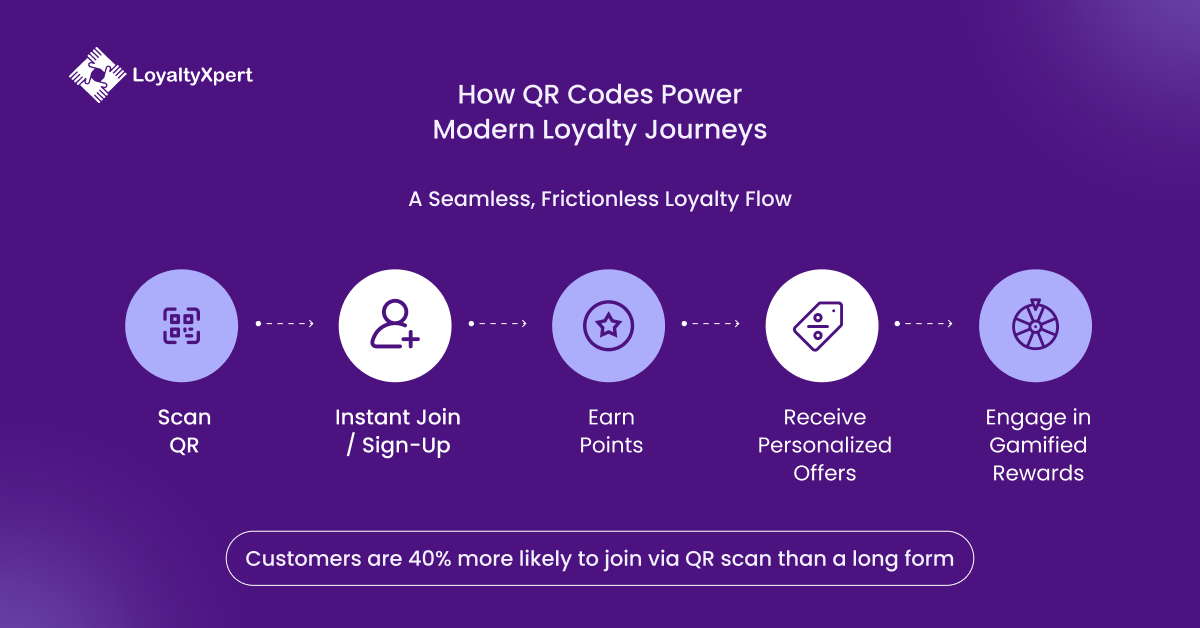
Customers are 40% more likely to join a loyalty program when onboarding happens through a quick QR scan instead of lengthy sign-up forms.

Why QR Codes Help Loyalty Programs Succeed

QR codes are not just a trend—they solve real challenges faced by businesses today. As customer expectations rise and mobile-first behavior becomes the norm, QR-based loyalty solutions offer unmatched benefits.

1. Easy to Implement and Accessible for All

QR codes are simple to generate and place anywhere—store shelves, print materials, websites, or even product labels. For smartphone users, scanning takes seconds. This makes QR-based loyalty systems extremely scalable, even for small brands or growing businesses that rely on loyalty software for business.

2. Better Data Collection and Personalization

Personalization is the heart of modern loyalty. Yet many businesses still struggle to understand what their customers want. QR codes help solve this through:

  • Real-time data capture
  • Purchase insight tracking
  • Surveys and feedback forms
  • Behavior-based segmentation

This data enables brands to tailor offers and build experiences aligned with customer interests, enhancing the overall value of QR codes in loyalty programs.

3. Stronger Customer Engagement and Retention

Personalized rewards, easy redemptions, and instant interactions create higher customer satisfaction. Engaged customers return more often, buy more frequently, and show stronger loyalty. This boosts customer lifetime value and lowers acquisition costs, a powerful advantage for brands scaling digital loyalty programs.

4. Higher ROI and Revenue Growth

Businesses using QR-based loyalty solutions report higher campaign engagement, more redemptions, and increased repeat purchases. Loyal customers spend more, choose preferred brands consistently, and contribute significantly to revenue growth. QR-driven insights help measure ROI and optimize future campaigns.

5. Counterfeit Detection and Product Authentication

One of the biggest emerging benefits of QR-based loyalty systems is product authenticity. With counterfeit markets expanding rapidly, brands use unique QR codes on products to:

  • Verify genuine items
  • Track supply chain movement
  • Protect customers from fake goods
  • Strengthen brand trust

This adds a powerful security layer to modern loyalty initiatives, setting the foundation for the future of loyalty programs.

? Did you know?

QR code usage in India has grown so rapidly that more than 70% of shoppers now prefer scanning a QR over typing details manually—making loyalty enrollment faster than ever.

Opportunities from QR-Based Loyalty in the Modern Market

Every business today is battling the same challenge—customers are moving faster, switching brands easily, and expecting more value at every touchpoint. This is where a QR code loyalty program becomes a powerful competitive advantage. It seamlessly connects the online and offline worlds, giving brands new opportunities to engage, reward, and understand their customers.

1. Integration Across Apps, CRM & Loyalty Software

One of the biggest strengths of QR codes in loyalty programs is how easily they integrate with:

  • Mobile apps
  • CRM systems
  • POS systems
  • Loyalty software for business
  • Digital wallets and payment systems

This makes every interaction – store visit, purchase, feedback, or referral—trackable and instantly rewarding. Whether a customer is shopping online or in a retail outlet, the experience stays consistent, unified, and frictionless.

2. Turning QR Scan Data Into Actionable Insights

Every QR scan tells a story. It reveals:

  • What customers are buying
  • When they buy
  • Which channels do they engage with
  • What type of rewards do they prefer

This data helps brands segment users more effectively and push targeted offers, improving conversions and strengthening loyalty.

  • Gamification, Tiered Rewards & Dynamic Offers

Modern dynamic QR code loyalty systems allow brands to do much more than offer static discounts. They enable:

  • Spin-the-wheel rewards
  • Mystery points
  • Tier upgrades
  • Limited-period rewards
  • Location-based offers
  • Event-specific campaigns

How QR Codes Power Modern Loyalty Journeys

This makes the loyalty journey interactive and exciting—something today’s mobile-first customers genuinely enjoy.

Operational & Strategic Benefits for Businesses

Beyond customer engagement, QR-based loyalty brings measurable improvements to business operations.

1. Real-Time Data Collection & Reporting

Unlike manual or paper-based systems, QR scans provide instant data. Brands get real-time visibility of:

  • Redemptions
  • Customer participation
  • Campaign performance
  • Store-wise activity

This allows faster decision-making and smarter planning.

2. Better Tracking of Campaigns & Promotions

Every QR code is trackable. Businesses can instantly see which campaign, location, or media asset drove the most scans. This eliminates guesswork and makes marketing budgets more effective.

3. Smarter Segmentation & Personal Targeting

With scan data linked to purchase behavior and customer profiles, brands can segment users with greater accuracy and deliver highly relevant offers—boosting loyalty and repeat purchases.

3. Reduced Operational Overhead

QR-based loyalty reduces:

  • Printed coupon costs
  • Manual data entry
  • POS complexity
  • Fraud related to paper coupons
  • Time spent managing physical cards

For many brands, shifting to digital loyalty programs directly translates to lower costs and higher efficiency.

Best Practices & Challenges to Consider

While QR-based loyalty solutions are powerful, they work best when implemented thoughtfully.

1. Prioritize Data Privacy & Ethical Use

Customers expect brands to protect their information. Ensure compliance with privacy laws and transparent data practices.

2. Encourage Digital Participation

App-based journeys, mobile-friendly design, and instant digital rewards ensure higher scan rates and better customer satisfaction.

3. Keep the User Experience Simple

Scanning, earning, and redeeming should feel natural. Avoid long forms, complicated flows, or heavy app downloads.

4. Use Analytics to Measure Success

Track:

  • Scan rates
  • Redemption activity
  • Repeat users
  • Engagement trends
  • Demographic insights

These metrics help refine loyalty strategies continuously.

5. Combine QR Data With Broader Customer Insights

Blend data from QR scans with:

  • Purchase history
  • Feedback
  • Demographics
  • Browsing behavior

No CTA found.

This gives a 360° view of the customer and powers advanced personalization.

Future Trends: How QR-Based Loyalty Will Evolve

The future of loyalty programs is deeply connected to mobile-first behavior and contactless experiences. Here’s what’s coming next:

1. QR Integration With Mobile Wallets & Digital IDs

Seamless checkout + auto-loyalty accrual will become the norm—making earning rewards effortless for customers.

2. AI/ML-Driven Personalization

Loyalty platforms will use AI to analyze QR scan patterns and deliver hyper-personal offers based on individual behavior.

3. True Omni-Channel Loyalty Journeys

QR codes will unify in-store shopping, eCommerce, social media shopping, and app interactions into a single loyalty ecosystem.

4. Rise of Specialized Loyalty Providers

More loyalty program companies in India and globally will offer turnkey QR-based loyalty platforms, helping brands launch sophisticated programs without heavy tech investment.

Conclusion

QR code loyalty programs are no longer an add-on — they are becoming the backbone of the future of loyalty programs. As customers move toward mobile-first, frictionless, and hyper-personalized experiences, QR codes bridge the gap between physical interactions and digital loyalty journeys. With the right technology partner, businesses can turn every scan into data, insights, and long-term customer engagement.

If you’re ready to upgrade from traditional loyalty models to a smarter, QR-powered digital loyalty program, LoyaltyXpert can help. Contact us today or book a quick demo to see how QR-based loyalty can transform your customer experience and retention.